Alex Ross on the unnatural etiquette that guides applause (emphasis mine):
In the eighteenth century listeners often burst into applause while the music was playing, much as patrons in jazz clubs do today. The practice seems to have died out in the course of the nineteenth century, although audiences almost always applauded after movements of large-scale works. Then, in the early years of the twentieth century, the idea took root that one should remain resolutely silent throughout a multi-movement piece. …. The work itself should dictate our behaviour, not some hard-and-fast code of etiquette.
Ross recommends:
Perhaps concerts should become, in a way, more old-fashioned — more local, communal. … [I]nstitutions might work on strengthening the bond between performer and public — remarks beforehand, gatherings afterward, and, certainly, a relaxation of the Rule.
Applause makes me uncomfortable. And I’m not alone. Rarely, am I truly moved by a piece, a performance, a sound, a talk, that I burst into clapping. Moved sure, but hand clapping? Is it the natural reaction that our body wants?
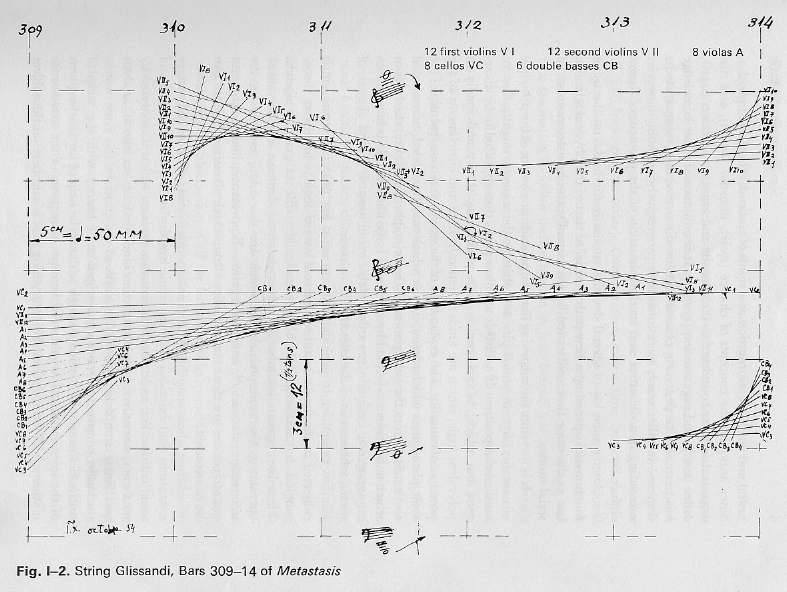
Alex Ross in The New Yorker (subscriber only) on composer Iannis Xenakis who translated parabolic shapes into music, working out his musical and visual ideas side by side:
He drew ruled parabolas on graph paper, then translated the shapes into music, mapping them as expanding web of glissandos. (The Beatles roughly echoed that effect in the orchestral crescendos of “A Day in the Life.”) A few years later, when Xenakis worked on the Phillips Pavilion [Xenakis was an engineer for Le Corbusier and a mathematician as well] he cast similar shapes in prestressed concrete.
He was searching for some measure of unity in his musical notation, and was bothered by the irrelation between the geometric progression that defined the pitches of notes in the 12-tone scale, and the additive properties that conventionally pertain between note lengths and bar lengths. So he devised his own musical Fibonacci series to articulate the percussion and the string episodes in Metastasis.
I have never made trials or experiments. Whenever I had something to say, I have said it in the manner in which I needed to be said…I can hardly understand the importance given to the word research in connection with modern painting. In my opinion to search means nothing in painting. To find is the thing.
In other word, he was improvising. This is, according to Jonah Lehrer, is how geniuses are supposed to work:
They are epiphany machines, pulling breakthroughs from thin air. Once the epiphany arrives, the artist immediately recognizes its importance, and rushes the idea into paint or verse or melody.
He goes on to compare the difference between “conceptual innovators” and “experimental innovators,” for instance jazz and rock music. Rock musicians don’t age well; the patient craftsmanship of jazz musicians leave them creative long after their rock counterparts, but both are needed.
The point is:
[C]reativity only exists in plural — there are many different ways to invent something new — and must always be understood in its cultural context.
We’re creating content in real time so it’s culturally relevant, socially meaningful, and adjusted for expectations at hand. Search isn’t the thing, it’s finding and creating.
We all had to play two instruments. Piano, “and.” Regardless, the music was classical. All structure, baroque. As I got older, I still picked up instruments, but always played within classical lines. Improv, and in particular, jazz, have always been a fascination to me because they’re a downright mystery. This is what brought me to the making of Kind of Blue.
In the spring of 1959, seven musicians got together, some for the first time. When they arrived that day, each received a slip of paper with rough markings on it. Miles Davis, the organizer, had just handed them a little piece of history. You see, with this gesture, Miles Davis introduced something called modal jazz — a way of approaching improvisation unlike what had been seen before. In contrast to the complex chord progressions of the preceding years, modal jazz was simple. It was a mode, a scale, a framework.
Frameworks for improvisation
Instead of the control coming from the composer (read: the designer), modal jazz promotes a sense of discovery. It doesn’t reveal everything; it holds back in order to let go. This loose framework, then, gives way to co-creation.
And with recent talks, posts by people I look to for inspiration and read often talking about similar ideas, suddenly I can’t help but see improvisation everywhere! Perhaps you will too.
In realtime
See also: Some more background included in Web Anatomy: Interaction Design Frameworks That Work. Excerpt available here by permission.
Like never before, people are improvising. Whether it’s for the realtime web or the realtime world, people are coming together in shared experiences, and rounding them out with personal stories, etiquettes, and values. They’re finding uninscribed rules in frames of reference — as didactic as form fields, as motley as urban landscapes. The designer’s role, then, shifts. Designers introduce the frames that audiences interpret. The audience is no longer just a spectator; the designer no longer the only creator.
In the realtime web, we’ve focused a great deal on the latest noise. But … what may matter most about realtime capabilities is the user experience that’s enabled. And the best use for realtime communications on the web is not to simply bring in the most recent information on a topic, but rather to make clear that others are experiencing or interacting with the same content at the same time.
See also:
Oral poets, back to the studies of Lord and Parry discovered epic poems were created and composed in the same moment.
No matter what the shared experience — be it part of a TED audience, a jazz improv group, a Twitter exchange, any shared audience — there is a common construct: the subject matter is such because of the improvisation. The framework (or as Frank wonderfully names it “tables”) merely suggests a possible dialog. And it’s the way the designer designs that suggestion that becomes paramount. How detectable is that suggested framework? And how do we design so that we’re setting out opportunities for audiences to take advantage of (or not)?
The improv overlap
Design is shifting from the creator to the consumer, yet it’s the place in the middle, the place where they play off one another, where new meaning is created. Frank Chimero recently talked about coming to jazz as one model for improvisation:
Learning about the history of the music and listening to musicians talk about jazz music, I heard things that made design make a bit more sense. Jazz is about improvising. It’s about having the musicians and audience meet the music halfway.
Exactly. (And do not miss the smart synthesis on pseudo-structures for more on this idea.) I would even say it’s more than a meeting point; it’s an overlap. The overlap is where new ideas — from both consumer and creator — come together, collide, discover new meanings. Miles Davis wanted to capture the spirit of discovery in his music. So at the intersection, how do we provide just enough constraint to allow for free-form discovery? How do we design for improvisation?
Constraints for creativity
When people talk about improvisation, they use phrases like “flying by the seat of my pants” and “winging it” — nomenclature that suggests being untethered. But in fact, improv is just the opposite. Its constraints set audiences free. They set rough guidelines for what’s to come. (See the emergent grammar of hashtags, the format of Humble Pied, or even something more scripted.)
Whether we consider our framework a browser, a city, or something unknown, we create the notes that allow audiences to improvise the greater whole. Just as Miles Davis created a new form of jazz that allowed a new generation of musicians to play beyond themselves, so do we have the opportunity to create frameworks for audiences to create in realtime.
Design in terms of expectations
See also: Visualization of Coltrane’s Giant Steps, which characterized the complex chord progressions that preceded modal jazz.
Back to music. “Music is the pleasurable overflow of information,” according to Jonah Lehrer. When we listen, our brain makes order from the caucaphony of notes to make sense of it. In other words, when we listen, we don’t hear notes. We hear sound in motion. (Consider that! Sound in motion!) Of course, our brains know there are individual notes. But we hear motion because our brain wants to find patterns and hears, “in terms of expectations.” Our brain orders sound to keep up.
More from Lehrer on this:
Music works by subtly toying with our expected associations, enticing us to make predictions about what note will come next, and then confronting us with our prediction errors. In other words, every melody manipulates the same essential mechanisms we use to make sense of reality.
If this is the case, we already think in terms of what will come next. As people, as designers, we think in terms of expectations. We can turn scraps of sound into a symphony. Just like Miles Davis and his sextet turned scraps of paper into one of the best-selling albums of all time. Just like we, as designers, turn scraps of paper into transformative designs. This is our ability. To frame experiences; to extract information; to make haphazard notes and make sense of them; to imagine the future while the present is in motion.
As designers, we write the notes and our audiences improvise the music — whether it be interfaces, gestures, symphonies, or something much greater.
Whatever you think of classical music, Mozart and even Beethoven were improvising too, specifically during solos:
It is believed that Mozart improvised his own cadenzas at concerts. …. This place in his scores was always left blank, with a fermata (pause sign) over the six-four chord, leaving the choice of what to play to the performer’s discretion.
So why is his music written down at all?
We could easily have remained ignorant of what sort of thing Mozart himself did in his solo concerti when the cadenza moment hove into view. But fortunately for us, Mozart’s students didn’t share his improvisational gifts, and so, when a pupil of his was going to play one of his concerti, Mozart accommodatingly wrote out an improvisatory-sounding cadenza for him or her (usually it was her) to use.
At these times, the “composer and the soloist were usually the same person, the requirement to provide the latter with an opportunity to show off was no great imposition on the former.” If the creator and the consumer, or the designer and the audience, are the same person or closely aligned, does that give one more license to improvise?
When musicians improvise, their brains turn inhibitions down and creativity up. Scientists set out to measure exactly what is going on in the heads of musicians, using jazz as the constant:
[T]hey go into what we call a “dissociated frontal activity state.” There’s this notion that someone like Coltrane is “in the zone,” he’s far away from the concerns of everyday life. And he is in some other place where all of these novel ideas are flowing out of him.
How does he do it?
The brain really alters itself into this creative mindframe where its purpose at that moment is to generate novelty and to decrease inhibition.
Consider that for a moment: improv decreases inhibition and increases novelty! As I mentioned recently, people are already improvising. With the emergence and adoption of a new set of tools and services, the line between creator and consumer has narrowed and, in many places, blurred completely. And this is the great opportunity for designers (or creators or any kind): to create room for this sort of free flow of ideas in our design process and in the products and services we create for people. Plan for improvisation. Make room for novelty. (These are not oxymorons.)
In the meantime, head over to hear a series on the field of “neuromusic,” research at the intersection of cognitive neuroscience and music.
In music one must think with the heart and feel with the brain.
“I love music so much and I had such ambition that I was willing to go way beyond what the hell they paid me for. I wanted people to look at the artwork and hear the music.”
So:
In 1940, as Columbia Records’ young new art director, he pitched an idea: Why not replace the standard plain brown wrapper with an eye-catching illustration? The company took a chance, and within months record sales increased by over 800 per cent. His covers for Columbia — combining bold typography with modern, elegant illustrations — took the industry by storm and revolutionized the way records were sold. …. He launched the golden age of album cover design and influenced generations of designers to follow.
His new book, Alex Steinweiss: Inventor of the Modern Album Cover, was recently honored.
Reporting in from the third-annual Interaction10 conference, one that is quickly growing to be my favorite. It is:
[E]ducation, inspiration and connection in the world of interaction design. Our goal is for you to go home with your brain full of new ideas, tools and strategies, your body tired from staying up late enrapt in fascinating conversations, and your life enriched by friends new and old.
And excited to be giving a talk this morning on improvisation and design. As you might expect, there is sure to be lots of mention of the crossover between music and design. Hope to see you if you’re here.
The folk psychology belief “time flies when you’re having fun” is so powerful and ubiquitous, the researchers say, that whenever we feel an event has passed more quickly than we expected, we infer that we must have been enjoying ourselves, and vice versa for events that drag.
In one test:
The researchers first had dozens of undergrads look through passages of text and underline any words with adjacent repeats of a particular letter.
In another:
When participants read a scientific article challenging the “time flies” adage, speeding up their subjective sense of time no longer increased their enjoyment of a word-based task.
Which means:
‘Taken together, these findings have important implications for understanding and changing hedonic experience,’ the researchers said. … [T]he first thing to do is minimise people’s access to accurate time cues. Next, alter their subjective time perception. There are numerous ways to do this. For example, physiological arousal speeds time perception so a free coffee at the start of a long queue could work (as long as no clocks were in sight). Even music that’s incongruent with the context (e.g. Chinese music in an English restaurant) has been found to speed time. Finally, you need the surprise moment, when people are alerted to the true passage of time. That provokes in people the sensation of time having flown, followed by the gratifying inference that they must therefore have been enjoying themselves.
If you think of the example of the jammed radio, the way to hear what you want out of the messy signals would be to listen really hard for the latest news while trying to filter out the unwanted music. The hippocampus does this more efficiently. It simply tunes in to the right frequency to get the station it wants. As the cells tune into the station they’re after, they are actually able to filter out the other station at the same time, because its signal is being transmitted on a different frequency.
Similar to being connected to someone:
“You know how when you feel like you really connect with someone, you say you are on the same wavelength? When brain cells want to connect with each other, they synchronize their activity,” Colgin explains. “The cells literally tune into each other’s wavelength. We investigated how gamma waves in particular were involved in communication across cell groups in the hippocampus. What we found could be described as a radio-like system inside the brain. The lower frequencies are used to transmit memories of past experiences, and the higher frequencies are used to convey what is happening where you are right now.”
Immediately, I thought of Merlin’s synthesis of procrastination as a way of “asking the world for answers” when we’ve forgotten who we are. In this regard, tuning in to one thing (perhaps to the wrong thing) could be a lack of connecting to another:
Paraphrasing liberally:
Procrastination comes from a lack of confidence from one of three things: – Temporarily forgetting who we are and what we want to be – Temporarily losing track of what we should be paying attention to – Losing track of what our options are for doing something about the first two
There’s a great deal of meaningful things I’m leaving out about oscillation and the often-overlooked masterful mastering of oscillation. As I tune in to write a few talks that I’m signed up to give over the next few weeks, both are much needed and timely reminders.
Stephen Worth, director of the ASIFA-Hollywood Animation Archive, on the importance of skill:
Ever since Andy Warhol made “ideas without skill” fashionable back in the 60s, it seems to me that popular culture has been playing a game of “skill limbo”. How low can we go? How badly drawn can a cartoon be and still be considered a cartoon? How many drum machines and sequencers can we stack up to avoid having to learn a real instrument? How much plastic surgery does it take to make acting skills unnecessary?
Gladwellian-10,000 hours come to mind. He continues:
But when I see someone who has both an idea AND skill, I’m reminded just how doggone powerful and dynamic a creative artist can be. I’m sick and tired of accepting “half a loaf”. Speak to me with eloquence. Dazzle me with your skill. Communicate an important idea. I insist on “all of the above”.
You said it, Stephen Worth, with both idea and skill. And as Richard Sennett reminds us, “making is thinking.”