Jonathan Gold, LA Weekly food critic, on food supplanting music as cultural barometer:
In a lot of ways I think food is starting to take the place in culture that rock and roll took 30 years ago, in that eating has become incredibly political. And just as the street has always dictated fashions on music and other things, it’s starting to happen that way in food.
Yet, there are still those who just want to know how to cook a simple steak. And that seems as rock and roll as it gets.
I think you need the technology that suits the way your brain works. Sometimes you need your thoughts to go down your arm in what feels like a direct feed via pencil or felt-tip to paper, sometimes you require a more formal “sit up and address a machine”.
One would have to get creative about making a clackity noise with a pencil or, harder still, something felt-tip, but I’m certain an assimilation is possible.
I am going to be at The Museum of Modern Art on Wednesday, December 2, 2009 from 10:30am to 3:30pm drawing people. I will then go to The American Museum of Natural History. I will draw there from 4:00pm to 5:30pm. I will then head to Times Square and draw from 6:00pm to 7:30pm. I will then walk to Grand Central Station and draw there from 8:00pm to 10:00pm. I will be drawing all day to commemorate the fact that I have now drawn just about 8,300 people for the project Every Person in New York. The population of New York is about 8,300,000 people. I have been working on this project for over one and a half years, almost everyday, and I have only completed One Tenth of a Percent of it.
[S]ome of the most present features of our daily environments abscond from our perception. Whether useful or inconsequential, organic or artificial, laden with symbolism or bereft of imposed meaning, they’re always there, so they’re never seen — and in this invisibility they acquire an entirely new sort of interest. A few years ago now, Nurri Kim told me about her intention to document a feature of the Tokyo streetscape that met all of these conditions, the ubiquitous blue construction tarp.
This, excerpted from Adam’s essay in Tokyo Blues a book of photographs by Nurri Kim (with a foreword by Anne Galloway), and the first project from Do projects, a combined effort by Adam, Nurri, and a loose network of friends and collaborators. Committed to “learning by doing,” Do projects is about books, ideas, and an ambition to design and make meaningful things.
The above excerpt serves for the book, but could just as well as serve for what I know of their approach — and why I’m particularly enthusiastic about this experiment. They bring focal attention to an environment, bringing a kind of tangible register and vernacular to systems previously unseen.
Years ago, I spent some time living in Japan surrounded by the system of blue tarps of note here, categorizing them mentally, as I’m wont to do. Before meeting Nurri, I thought I’d been alone in noticing their awkward yet somehow graceful purposings for use. I was not, I was delighted to find.
A congratulations, and to the start of purposeful noticings.
A village in British Columbia has scored a North American first by becoming something called a Cittaslow, or Slow City. A Slow City is an offshoot of the Slow Food movement; it’s a sort of quiet resistance to fast lane, drive-thru homogenization. The seaside town of Cowichan Bay, north of Victoria on Vancouver Island, doesn’t have a single fast food restaurant in sight.
Don Genova, of public radio’s “Living on Earth” puts it into, well, context, “[I]t looks like this idea of slowing down life in small towns in North America is gathering speed.”
Often real life is boring and problematic. I love the edited version of it.
Jeremy Denk’s take on simplicity versus complexity as told through Chopin:
Chopin’s simplicity rebukes Chopin’s complexity. The Genius of Chopin is sitting there, in his self-rebuke, sandwiched between an almost-clichéd chromatic transition, a pedal point, and a lyrical slow section rocking between the two most common chords there are: this glimpse of screw-you-I-can-write-something-so-beautiful-that’s-made-of-almost-nothing, as an unearthly transition between things that are also almost nothing.
“Almost nothing” as a theme. I like this. As people who create things, we’re often striving to achieve thoughtful reduction ourselves. Denk continues:
One of the great and strange elements of the Polonaise-Fantasie, one of its “themes,” is that the act of listening is woven into its fabric. Chopin wants you to listen–carefully! thoughtfully!–to certain sounds, certain pitches, certain moments; the structure of the story he is telling is utterly dependent upon this listening. But he knows that listening is an inherently lazy activity, often thoughtless, often lulling itself into complacency. Just look around the boxes of Carnegie [Hall] some night if you don’t believe me on this.
Listening is lazy. Of course it is, but I’ve never considered this. I immediately thought of McCullough’s reference to Walter Benjamin, “architecture is experienced habitually, in a state of distraction.” Architects must then weave ways to flow people and resources through built environments. How does Chopin do it?
Chopin writes “enforced” listening moments into the piece–strangely arresting moments, like that F# held, alone, then heard against an astringent dissonance, then heard alone again, then heard against the “correct” dissonance…
Enforced listening moments. Intentional pauses woven into the experience (here music, but elsewhere they could be websites, products, service experiences, architecture) that make people “act, stop, listen” as Denk describes them.
As designers, for all the simplicity we intend in our work, for all the intentional moments we craft, what enforced listening moments are we creating? What rhythms are we designing? Where’s the F#?
At the kitchen table, where ideas started, I founded The Greenridge Gazette. I didn’t read other newspapers at the time; I was eight years old. Yet I liked the simplicity of gathering stories from people to print on a page — for a profit. It seemed a step beyond lemonade. So it began.
And so did the paradox of a journalist: I needed content, but the spatial configuration and social territories of my context limited me — namely: I was not yet allowed to cross the street. My narratives, therefore, lay within the boundaries of one small-town block. Thus, the burden on the people of that block were great.
Emergent rhythms
Perhaps this is why Cicero could, in part, write, “For walk where we will, we tread upon some story.”
I knew nothing of networking with busy people or how to ask questions. But for each interview I did, there was a rhythm. I sat with people in their living rooms, at pianos, in gardens, and gave them something in return — I listened. Sometimes, it was brief, on the porch for a few moments, a few words, then out. Each interviewee received “an issue” of the paper in return (GG was marginally profitable in the end; lemonade would have been a savvier route). In the end, I resolved my content; they were returned respect for their time and saw their name in print.
The people pattern
Whatever you think about reaching out to people, there’s a pattern. It’s not a pre-meditated or a cold one, but a people-centered pattern that when considered, can bring satisfaction to both sides.
We’re often in a position of asking strangers for things: speaking at our events, advice, customer support, exchange of services, lunch, counsel — the list is long. And the simple fact is: people want to be helpful. But they also demand value in return; some are extraordinarily pressed for time, others quite the opposite. But all want two simple things: to be listened to and to receive value.
When contacting any person for the first time, there’s a pattern, whether getting in touch by email, by phone, or in person:
1: Cite a familiar reference + What it is + Brief details
Start out giving a familiar reference (e.g., Max suggested I email you...) in the first five words of an email or a phone call. Make the person comfortable knowing there’s a familiar reference between you. Go on to mention, briefly, what it is you’re talking about with a point or two of detail. Nothing more.
2: Compliment + Ask
Why are you going out of your way to speak with a stranger (with only Max in common really)? Compliment this person by letting him or her know what skill, content, or talent has brought you to this point of communication. Then, swiftly and clearly: ask the question you need to ask (e.g., will you do me the honor of…).
3: Reference value, micro + macro
How will this person be compensated? Can you take him to lunch? Will you pay her for speaking at this event? Will you mention her on your next television spot? Whatever it is that’s of value to the other, offer that. And make it clear when, how, and how many. End by making it clear how this will benefit his or her profession at large.
4. Include a gracious closing
Always.
These communications, if in written format, should be kept to no more than 100-200 words — as if you weren’t invited past the porch. On the phone, the equivalent. If people want more, they’ll ask. But let them be the ones to instigate.
Haruki Murakami on the difference between inevitable versus optional:
Pain is inevitable. Suffering is optional. Say you’re running and you start to think, Man this hurts, I can’t take it anymore. The hurt part is an unavoidable reality, but whether or not you can stand any more is up to the runner himself. This pretty much sums up the most important part of marathon running.
I often think about Murakami’s marathons with regard to “busy.” Busy is inevitable most of the time, yet everyone just has a different threshold for it. Those who push past a particular threshold, who start to think, I can’t take it anymore, but are committed with every ounce of their being to an idea, they keep running, keep going — their unavoidable reality just isn’t optional.
[T]he list maker often is compelled to acknowledge that each accounting predicates an uncountable number of shadow lists, alternative choices abounding. Such recording seeks order even as the process implies the chaos of ever-lengthening inventories — thus the “infinity” of lists.
On the job of the list maker:
If the list maker’s first task is to choose, the next might be to make more from those choices than mere addition: A list can tell a story. What Eco dubs the “rhetoric of enumeration” we might understand as the drama that flows from rhythmic excitation. In Leaves of Grass, Whitman’s incantatory compilations rise to crescendos and fall back to rumination, taking accurate measure of the pulsing landscapes the poet feels compelled to swallow whole.
There is a tempo and a shape to lists, be it aural, visual, or curatorial, and ultimately, what is present can be less fascinating than what is absent.
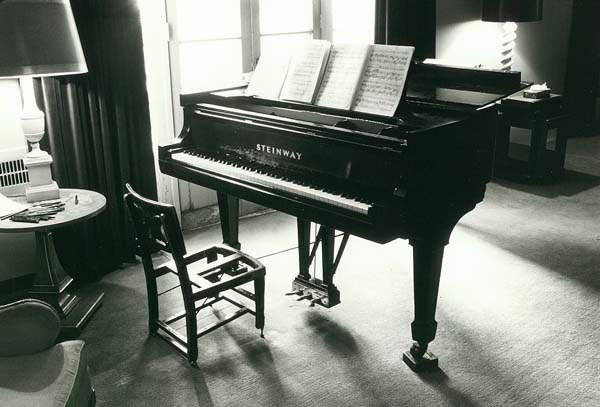
Glenn Gould was renowned for the control he had over every aspect of his playing environment:
He invariably insisted that it be extremely warm. [T]he air conditioning engineer had to work just as hard as the recording engineers. The piano had to be set at a certain height and would be raised on wooden blocks if necessary. A small rug would sometimes be required for his feet underneath the piano. He had to sit fourteen inches above the floor and would only play concerts while sitting on the old chair his father had made. He continued to use this chair even when the seat was completely worn through.
There’s something quite admirable about those who know what they need and demand it, repeatedly — to the point of threadbareness.
The past is so often unknowable not because it is befogged now but because it was befogged then, too, back when it was still the present.